Blog Archives

Medical Adventures and SHTF
As you know, I’ve been absent for a while and I’d like to share with you a bit of what happened and how it would play out in an emergency scenario.
In January 2014, after having tried unsuccessfully for years and being told it was impossible, I became pregnant. Almost right away there were issues. I started bleeding heavily and was told I had miscarried. We ran some blood tests and my hormone levels weren’t going down so the doctor scheduled an emergency ultrasound to be followed by a dilation and cutterage (d&c) to remove the failed pregnancy. The tech at the ultrasound place asked if I was dating the pregnancy and sadly I replied that no, we were confirming my miscarriage. To our surprise, the baby was still there, heart beating and jumping around. The problem was not the baby, it was a huge sac of blood between my uterus and the placenta. This is called a subchorionic hemorrhage and can be very dangerous, so I was sent to the top high risk obstetrician in the city. The blood, it turns out, could do a few things; it could grow and disconnect the placenta thus ending the pregnancy. It could stay as is and not allow the baby room to grow. It could bleed out or it could re absorb. In any case, I wasn’t allowed to lift more than 5-10 lbs, raise my heart beat or sweat or do anything strenuous. I continued to bleed until I was 17 weeks pregnant.
At my 13 week tri-scan, I screened positive for neural tube issues. The baby could be missing its head and/or part of the brain, could have an open spinal cord such as spina bifida or could end up having Down syndrome. The doctors encouraged me to think of my options because there was the chance of miscarriage, stillborn or no quality of life. I chose to keep on and get more tests. After rigorous testing, it was determined that baby was healthy and I had screened positive due to the extra blood protein from the hemorraging.
At 23 weeks (1 week before viability here), the baby had stopped growing. At this point I was at the high risk clinic about once a week so we listened to the heart beat and booked yet another ultrasound for the baby. If he still wasn’t growing, we’d need to get him out of there and into the NICU. Thankfully, he put on an oz between visits.
Then, as if this wasn’t enough fun, I developed gestational diabetes at 30 weeks. I was expecting this as I had it with my previous pregnancies but it showed up late this time. This meant a huge diet change, multiple blood tests a day and 4 shots of insulin into my abdomen a day. My doses kept changing because the way the baby was reacting to the sugars and insulin.
Because of how high risk I was, the doctors encouraged labor as much as possible. I endured 3 painful membrane sweeps, ate ridiculous food and tried every old wives tale. Nothing worked and the little guy stayed where he was. Turns out he was transverse (so across my belly instead of head down). I then, very hugely pregnant in the middle of August with no a/c, had to do all sorts of crazy yoga poses etc to get baby head down. I wasn’t allowed to go past my due date and my OB booked an induction for the day of. I could be called in anywhere from 6 am to 10 pm but if not by noon, it probably wouldn’t be happening. I of course couldn’t sleep so was wide awake by 6. No call. Took my big kid to school for 9. No call. Finally had early dinner at 4, with still no call. At 5:30 I was rushing to the hospital with bad cramps and broken waters. Around 5 hours later I had my boy. He was healthy but with low blood sugars so the NICU was still an option. Finally they let me go home after two nights and then it was just me and a newborn and my big kid.
I was supposed to take things “easy” after child birth. Yeah right. Landed myself back in with the Dr because I was hemorrhaging from too much strenuous activity (aka taking care of the household). Finally, everything got sorted and I thought life was back on track.
Fast forward to February. Baby H was now 5 months old and the rest of us had adjusted to the new addition fairly well. Around the 21st I had a stomach ache but attributed it to the crappy dinner we had eaten to celebrate a birthday. But it didn’t go away all night. By morning I was fine but anytime I ate, it hurt within an hour again. So I thought I had a stomach flu, which was going around anyways. By the 24th I called the Dr because maybe I had something viral? It was a yucky stomach bug but I didn’t think much of it. Saw the Dr on the 26, she palpates my stomach but I had no pain response etc so she prescribed me pills for acid reflux but ran some blood tests just in case. February 28 I got a call before the Dr office even opened telling me I needed to go to the emergency room.
In the emergency room they told me my pancreas had shut down, my liver was almost pooched and my gallbladder was definitely shot. I had several blood tests, ultrasounds, an MRI etc. Turns out I had a gallstone stuck in my common bile duct. I should have been in excruciating pain but I have a high pain tolerance (which the Drs have said before). The other patients with the same problems were taking morphine. I only took anti nauseants because I wasn’t allowed food for 6 days. On the 5th day I had an endoscopy where they stuck a camera and tube down my throat, through my stomach and cut a hole in my bile duct to push the stone into my intestines so I could pass it that way. Well the stupid stone got stuck on the camera and I have it to this day (it has been named Herman by one of the nurses). I immediately felt better and my toxic blood levels dropped significantly. I stopped looking like Mr. Burns. On day 6, I had 4 incisions made into my abdomen and they pulled out my gallbladder and repaired a hernia that I had no idea was there (turns out the hernia was of their own making and is quite common with abdominal surgeries). It was around a 5 hour surgery. Finally, I was allowed to go home and have my kids again!! This emergency room visit that my Dr had said would take a couple hours had turned into the hardest week of my life. The Drs then dropped the bombshell on me that I couldn’t lift 10+ lbs for a month or I could pop the hernia right back out or rip my stitches. They expected me to somehow be a mum and basically not move. My mother showed up twice a day to move the baby from the bedroom to the living room and back. I could barely nurse since I was able to lift him (or be on my sides). I lasted two weeks before I started lifting him (which out of 4 wasn’t too bad for stubborn old me).
My most recent medical adventure (besides of course the regular sort of flus, colds, childhood illnesses and mastitis) has been a breast cancer scare. So far the results have been negative (ultrasound, antibiotics etc) but we also have no answers. (update march 2020, it wasn’t breast cancer, but now have a new breast cancer scare in the middle of a pandemic. Mammogram/ultrasound/biopsy scheduled for next week)
Sorry for the long explanation, the point is: if the SHTF, I probably wouldn’t have survived most of this. I have medical training but I certainly not a doctor. Even my surgeons were stumped, I had a 4 mm stone blocking my duct and I felt fine. I was literally dying and had no clue. After my gallbladder went through pathology, I was told there had been a 9 cm stone in there as well. So think like a grapefruit or just shy of a softball. My gallbladder could have easily ruptured. How do we prepare for this? I might have been able to (poorly) perform the surgery on someone else but there’s no way I would have a diagnosis without blood tests and imaging.
My best answer I suppose is to make sure yourself or someone in your group is medically trained in some form and to keep everyone at peak health through diet, exercise, proper sleep and regular doctor visits.
Food Storage Bug Out Bin
My food storage is mostly on shelves. But I do have the typical 5 gallon buckets full of food as well. The buckets stay with my food storage and are filled with pasta, rice, beans, and a variety of foods all mixed in separate bags. This way, if I need to move my food storage, I can grab the buckets and not be stuck eating 100 lbs of flour.
But, if I need to bug out in a hurry and can’t get to my food storage, I keep a heavy duty Rubbermaid bin with my bug out bags. It weighs about 30 lbs and is easily grabbed to throw into the car and go. We all have various food items and MREs in our bags, but this is just something a little extra.
It contains rice, pasta, sugar, tea (can’t live without tea!), fruit, granola bars, fruit snacks for the kids, a variety of spices, water purification tablets, and anything else I wanted to add. Again, this is separate from my bug out bags and wouldn’t do me any good to grab on its own and contains mostly doubles of my bug out bag and food storage.
Its a good idea to keep a little bit of your food storage separate like this, just in case. Your basement could flood, you could be cut off from the rest of your house, you might have one minute to grab the kids and get out or, if your food storage was raided, most people aren’t going to check a storage bin that’s kept completely away from the rest of the food. Give it some thought and see if it works for you.
Car Kits
Its that time of year again and several people are hitting the roads to visit friends and family for the holidays.
While the holidays can be hectic, this is also the time the weather can get nasty. Its no time to forget about emergency preparedness. About two years ago, several cars were stuck on a local highway here for about three days due to the excessive snow. The people were cold, hungry and unfortunately some people did pass away.
I recommend keeping a kit in the car just in case. Some simple items can save your life.

In the kit I have:
basic first aid supplies (gloves, bandages, alcohol swabs, etc)
a wind up radio with extra batteries so I don’t kill the car battery
some easy foods (granola bars, tuna, fruit salad for the kids)
manual can opener
hand warmers (these can be put in your sweater if needed)
a survival blanket (easy, compact way to keep warm, can also be used to signal for help due to shine)
a mini camp stove to cook with (please don’t use inside the car!!)
hand sanitizer (both for hygiene and as a de-icer)
light sticks (comfort item for children, can be used to signal)
book for entertainment
garbage bags (hygiene… when there’s no toilet…. )
a zip bag of cat litter – for a few reasons. Cat litter can help your tires to gain traction if stuck on ice, but I keep my car kit in a cat litter bucket. This is because my car keeps getting broken into and everything gets stolen. No one has stolen my “cat litter”. They did once open the lid and this is what they saw:

a bucket of cat litter… not really worth stealing. But underneath that sneaky cat litter, lays the real prize.

This kit is light weight (about 7 lbs) so can be carried if you have to leave your vehicle.
Some additional things to keep in your car at all times are: basic tools (tire iron, jack and jumper cables and KNOW HOW TO USE THEM!), a case of bottled water (do not eat snow, it will lower your body temperature, let it melt first if you have no water) and a weapon that you are comfortable using.
All that aside, please take your time going where you need to go, don’t drink and drive and be safe!!
Reusing your own soap
A lot of us have soap in our stocks, its a great thing to have around. In a SHTF situation, hygiene is paramount. Soap is generally cheap, but here’s a way you can save a bit of money.
I personally owned a soap business so I have a lot of soap scraps around but you can do this using the little slivers that are left at the end of the bar.
Grate or break down your soap into smaller pieces and place them in a bowl.

soap scraps in bowl ready for our next step
Put your bowl over a pot of warm water (double boiler). Do not let the water boil, as this gets your soap too hot. If you are using all bar soap (not glycerine soap) you may have to add a little bit of water to your bowl.
Be careful, the bowl and the soap will get hot. Melt the soap down and mix it together. When it is all melted, its time to take it off the heat.

Bowl of melted soap
Carefully pour your soap into molds. I have professional molds but this isn’t necessary at all. You can use milk cartons, silicone muffin tins, just about anything. (tip: if you want to make soap for barter or giving away PSHTF, pour your soap into ice cube trays.)
Once your soap is hardened (this can take anywhere from a couple hours to a couple of days), take it out of your mold and cut it into desired shapes and sizes. If you’re having trouble getting the soap out, you can pop it into the freezer for ten minutes and let it get cold, it should come out easily after that.

“poc” soap, ready to be wrapped.
It may not be pretty and it may be a blend of a lot of scents, but its soap, its functional and it was free.
To keep your soap for long periods, consider using shrink wrap or putting it into zipper plastic bags. If you used glycerin soap, it may develop a ‘dew’ or ‘sweat’, this is normal and does not affect the function of the soap.
The Ugly Side of Prepping
Prepping isn’t just about gear, food, water or ammo. It’s not even about knowledge (which of course is vital). You have to be mentally prepared. A lot of people think they are. I’m not so sure of that though.
In New York after Sandy, people were eating out of dumpsters. Gross? Get used to the idea. Even if you’re prepped with years and years of food, it could still happen that you might need to eat garbage. If you accept that possibility now, it won’t be so hard when it comes down to it.
What about self-defense? Most preppers have guns or other various weapons that they would use for self-defense. But most people have never killed someone. It’s a lot more than point a gun and shoot. Could you look someone in the eye and kill them? Can you handle the after effects? Even if you kill in self-defense, there is that lingering guilt. PTSD is not just a soldiers disease and it is not just from being in danger. Taking another human’s life is a big deal and takes a long time to get over. If it comes down to it, you need to be prepared to make that decision and defend yourself and your family. (A good book about this is On Killing, recommended to me by a veteran.)
Sooner or later, you may have to come to terms with the fact that even though you’ve spent hundreds of dollars and thousands of hours prepping, stocking, reading etc, it may not be there when you need it. Sh-t happens. You may have to unexpectedly bug out, leaving your stuff behind, someone may steal it, it may run out. Be sure to have more than one or two plans. You should have plans A through Z.
Bad people will be out there when the SHTF. Good people will turn desperate and do bad things. You need to be able to deal with them and avoid them when you can. Are you ready to loot a store to feed your family? Would you steal for them? Would you kill the guy down the street whose basement is full of MREs? These are things we need to consider. The ugly side of prepping.
Basic EDC
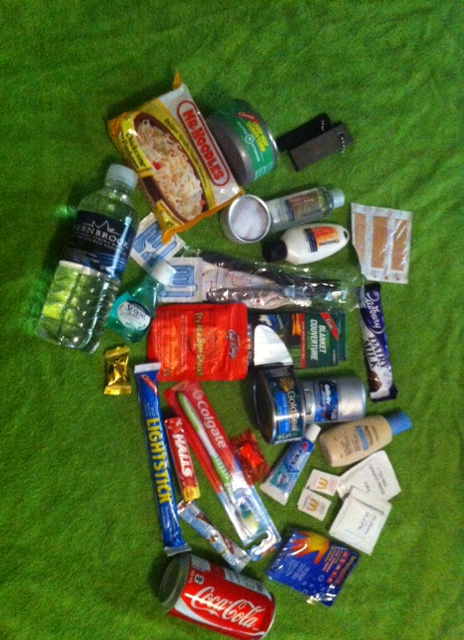
An EDC, or Every Day Carry, is a kit that you take with you everywhere. It is smaller than a bug out bag and a bit more than most people usually carry. It is a good idea to carry one of these in your backpack, work bag or purse. Do not leave it in your car (I’ll cover car kits another day).
A basic EDC has enough stuff to get you home should you be stranded at work or school. You can think of it as an extended overnight bag if you will, I usually have most of this stuff in my purse. A basic kit might include:
soap
shampoo and conditioner
toothbrush and toothpaste
a can of tuna or other high protein food
a higher carb option (as seen in the picture –ramen noodles)
chocolate or candy
space blanket
a way to start fire
a candle or other heat source
a flashlight or glow stick
tea, coffee or other hot drink
water
a higher sugar and energy content drink (soda or sports drink)
first aid items (the metal tin in my photo contains cotton, ibuprofen and other basic medicines)
Also included (but not seen in the picture) is some money, self-defense tools, a small notebook of basic survival information, basic maps of the city and surroundings, chap stick (which you can use as a fire starter in emergencies) and a book or set of cards in case you get stuck somewhere.
Bug Out Bags 101
A bug out bag is a bag that you keep full of supplies ready to go at a minutes notice in case of an emergency where you leave your home. It is also known as a GOOD bag (Get out of Dodge) or a 72 hour bag. There is a few different types depending on what your plan is. Be sure to use a heavy duty bag with good supports (such as a waist band and thick straps, possibly with metal framing).
A basic bug out bag contains everything you would need to survive for 72 hours away from home or as long as it would take you to get to your retreat spot, including:
Shelter (such as a tent and sleeping bag, making sure to buy weather appropriate)
Food (usually light weight such as dehydrated or freeze-dried and a way to cook said food ie: pot, mini camp stove or fire making implements)
Water or a way to purify water (here’s a handy mini filter I keep in my purse)
First aid requirements (bandages, alcohol swabs, gloves, gauze etc)
Any medications you or your family requires
Small amount of cash
Hygiene needs (toothbrush, toothpaste, comb, shampoo, fem care etc)
Self defense
It’s also a good idea to have a survival manual of some sort and a copy of any important documents (birth certificates, deeds etc which you can scan and put on a thumb drive)
Many people carry an EDC (everyday carry bag) which includes a lot of the stuff already mentioned but it is said in the prepper/survival universe: “two is one, one is none.” or as I say “rather too much than too little”. Your bug out bag should be as individual as you are. No one can tell you exactly what to put in your bag because we don’t know where you are or where you are going. I do recommend the above list as a starting point and that every family member have their own bag in case someone gets separated from the group. It is a good idea to keep your bug out bag readily accessible (in the front hall closet etc) so you always know where it is. Keep in mind this is a very basic list to get you started on thinking about what you might need. Just remember, you will have to carry this at least part of the time so make sure it doesn’t weigh you down so much that you can’t function. A good exercise is to strap on your bug out bag and go for a hike, see how far you can make it with the weight and adjust as necessary.
Heat Illness
All over North America, we have been having crazy heat waves. In some places, people have been without power due to bad thunderstorms. Today its only 91° where I am but the other day was 114° and most of my family was sick due to the heat (not to mention sweaty and miserable).
Its important to recognize the signs and symptoms of heat illnesses (hyperthermia), especially in a survival situation where you can’t just pop into the mall with air conditioning.
There are a few levels of heat illnesses which progressively get worse if you don’t take care of yourself.
Heat Cramps: are caused by not having enough water and being too hot. Symptoms include: thirst, sweating, irritability, gastro symptoms (nausea, vomiting) and of course cramps (particularly in the abdomen).
Heat Exhaustion: excessive sweating, dizziness, headaches, confusion, COOL to the touch as well as all the previous symptoms. Treat these people as being in shock (but do not cover with a blanket, instead remove excessive clothing).
Heat Stroke: skin will be hot in heatstroke because the mechanism that makes you sweat to cool you down isn’t working anymore. The person suffering might be in shock, confused, as it gets worse you can start seeing things such as unconsciousness and seizures.
Always try to get the victim out of the heat (indoors or into shade). If they are conscious get them to drink cool water (but do not force them if they vomit). To increase cooling you can sponge them with cool water or cover them with cool wet sheets. Obviously, if available, get your person emergency medical attention as soon as possible.
Try to avoid heat illnesses by avoiding heavy work in severe temperatures, wearing hats and staying hydrated.
Tips for Keeping Up Morale
Life post-SHTF will be very different than what we are used to. Different, harder, crueler and probably nothing like we expect it to be. We will have to deal with boredom (which can be a killer). People in the same environment for extended periods with a loss of privacy, a lack of hygiene, emotional issues, not to mention food fatigue and the digestive problems this can bring on will definitely need something to keep their minds off of things.
All of this is enough to bring anyone down. It is important to keep morale high. Boredom can lead to depression and depression can lead to a loss of will to live. This obviously is counter productive to our survival plans. So:
Give people a job to do, establish a routine. I’ve said it before, people thrive on routines. When you know what to expect and what your day looks like, it makes it easier to deal with.
Make sure you have entertainment. Books, games, decks of cards, coloring books for the kids, anything. If you don’t have a physical source of entertainment, put on a play, sing some songs or have a talent show.
Learn some skills that are fun and productive. Knitting or crocheting (which can be done with whittled sticks and plant made fibers!) can produce clothing, wash cloths, blankets and even nets for fishing. Wood working can make utensils (for eating and cooking), bows and arrows for hunting and improve your shelter!
Include some goodies in your preps. Candies or chocolates, stored in cool dark locations, can last almost indefinitely. I’ve seen freeze dried candies, as well as vacuum sealed mason jars of treats. (PLEASE do not throw out chocolate that has gone white! As a former chef I can tell you that it is NOT mold! It is called bloom and it is the fat in the chocolate separating. You can eat it as is or you can melt it down and mix the fats back in.) For the adults: a small bottle of your favorite liquor might be more to your taste. Or add a case of your family’s favorite soda to help ease the transition.
Above all else, never give up hope!
Hair in Emergencies
I’d like to thank Sandy for pointing out the hair aspect of a SHTF scenario.
Personally, I plan to either cut my hair very short or shave it to cut down on the possibility of lice, fleas and other parasites that might like to live in it. This might not appeal to you and then, if you do it, what happens when your hair grows back?
Well, you can keep it short or you can try and keep it clean. I have bottles of shampoo put aside just in case but I also keep small sample size bottles in our bug out bags. I can use them or there is always the potential for barter or just giving away to those that might be in need.
An easy way to keep your hair clean (well, cleanER) is to use a dry shampoo. This is great for conserving your precious water supplies as well.
To use a dry or waterless shampoo, put the powder in your hair, let it sit a few minutes and then brush it out.
A simple recipe is just using corn starch or baby powder (I’ve also used arrowroot powder) mixed with a few drops of essential oils – citrus is good for absorbing oils, tea tree is good for deterring bugs and lavender is anti-septic and anti-bacterial.
You can also keep a few hairbrushes and hair ties in your preparations as well as some razors if you decide to shave your head or to barter with.
 BurroakBurrow