Category Archives: food storage
Dehydrating Onions
Onions are such a versatile vegetable. They are cheap and add so much flavor, just about any savory recipe is better when onions are added. Dehydrating onions is quick and easy.
Begin by chopping your onions to the desired size. I usually do large flakes so the pieces don’t fall through the holes on my dehydrator but you could always mince them. Try to remove the thin pieces of skin that clings between the layers. (You can get a dehydrator like mine here)
Dunk your onion pieces into boiling water for about 30 seconds to a minute. They will turn slightly translucent when they are ready and they will be softer. Put them in a strainer and run cold water over them to stop the cooking process.
Pat the pieces dry with some paper towel and remove any extra bits of the skin (which will now be mushy and easy to remove). Arrange the pieces in a single layer on your dehydrator and turn it on.
My dehydrator doesn’t have a temperature control so I just let it run for about 5 hours to have the onions as dry as I need them. They end up paper thin. Recommended temperature for dehydrating vegetables is 135°. I recommend dehydrating these outdoors unless you want your house smelling like an onion factory.
Now here’s a recipe you can use your onions for:
Dry Onion Soup Mix
1 cup dehydrated onion flakes
1/3 c bouillon
1/4 tsp sugar
1 tsp parsley
Store the ingredients in an airtight jar until ready for use. I also like to throw in some other dehydrated veggies (carrots, garlic, celery and whatever else catches your fancy.) To make into soup, add 4 c of water, or for dip, add to a tub of sour cream.

Commonly Overlooked Preps Part 2
Here’s part two of the list I posted earlier.
Soil – I know people that have tens of thousands of seeds but no soil. What happens if you have to plant inside? Or if the soil where you are is too sandy or too much clay? A couple bags of decent quality potting soil are a good idea to keep around. I recently got 10 20 liter bags of soil for $10.
Pets- please don’t forget your four legged friends! Make sure you have food and water put aside for them. You can put aside a couple of bags of kibble that your animals usually eat but you can also make your own dehydrated pet foods. I have also begun to see dehydrated animal food at the specialty pet stores. Just remember if you’re using dehydrated foods to have enough water to rehydrate. Which brings me to the next point.
Water – Yes, most of us have enough to drink but a lot of preppers have dehydrated foods. You need to consider how much water these things will take to rehydrate. What about gardening? There’s really no way to calculate how much water you would need for gardening but using a rain barrel can offset that. But keep in mind, there could always be a drought and if you’re counting on a garden as a large part of your food you better have a back up plan.
Garbage Bags – most people plan to burn their garbage, which is fine. But how about disposing of a body? You don’t necessarily want to be handling that. Or if you have lice, you can bag your clothing and bedding for a couple weeks to kill the lice. You can also use it for quarantine purposes. Make your ill person strip down, bag the clothes and get them into something clean. How about blacking out windows? Using a heavy duty garbage bag taped over windows can help to hide any light showing through (you may have to double up though)
Commonly Over Looked Preps
As I talk to more and more people about their preparations, I’ve noticed some things that a lot of them seem to have over looked. (This, of course, is no judgment on them). Here’s a bit of a list of the ones that I’ve noticed over and over.
Entertainment – there is no way I can express how important this really is. It doesn’t matter if you have 30 years of food and water in your location, if you have nothing to do, you WILL go stir crazy. Put a book in your back pack and have everyone in your group do the same, or stock up your retreat location with some books you’ve never read. You can get books cheaply at garage sales or for free on buy nothing groups on Facebook. Get a deck of cards or some board games. If, for whatever reason, these things are not feasible for you, make a routine as soon as possible in the situation you’re facing. People thrive on routine. (example: wake up, make breakfast, check traps, have lunch, tend garden, make tools, etc). The last thing you need to deal with in a SHTF situation is cabin fever.
Oven mitts/Pot holders – almost everyone I’ve spoken to has the plan to cook over fires but none of them have oven mitts or pot holders to protect their hands. While this isn’t necessary and there are tools that you can fashion out of sticks to do the same thing, pot holders will protect your hands from the burns that you ARE going to get. You can get a pot holder at a dollar store or use a bandana or scrap of fabric.
Burn care- this goes with the pot holders. People will get burned; a lot of people are relying on fire to cook, clean and heat. There will be burns. I see the med kits people have and most of them focus on cuts or illness. While living in a SHTF scenario, yes, there will be a lot of cuts too but burns require care to prevent infection. Get a tube of burn ointment and bandages or whatever your preferred method of burn care is and have lots of it! (I use straight lavender essential oil for burns, more on this in a later post).
Water additives- it is easy to get diet fatigue when you’re drinking nothing but plain, sometimes boiled, tasteless water. I recommend, especially for those of you with kids, that you stock up on some additives such as Kool Aid, Crystal Light or whatever your favorite drink crystals are. These don’t take up much room and can add a sense of normalcy to your situation. (We use these in our bags, the kids love them)
Again these are just some of the things I’ve noticed and I’m sure I’ll add to the list. Make sure you think of how you’re going to survive and all things required if you had to start from scratch. A big part of prepping is planning!
Dehydrating Broccoli and Using It
To dehydrate broccoli, first cut it into bite sized pieces and blanch for about a minute in boiling water. This will help to maintain the green color (otherwise it goes a nasty brown). Plunge the hot broccoli into some cold or iced water to stop the cooking process. Drain to get as much water off as possible. I then spray with a bit of lemon juice (also helps the green color). Place on your dehydrator trays (not touching otherwise you get damp spots). It usually takes my dehydrator about 6 to 8 hours to dehydrate broccoli. Store as you would other dehydrated foods. Here is the dehydrator I use: (Excalibur Dehydrator)
To use your broccoli, here’s a simple but tasty broccoli soup recipe using things that are probably already in your food storage.
Broccoli Soup
3 cups chicken broth (approx 2 cans. You can also use water or water with bouillon cubes)
5 cups rehydrated (or fresh) broccoli (approx 2.5 cups dehydrated)
1.5 cups fresh (or rehydrated) onions (approx 3/4 cups dehydrated)
2 bay leaves
6 tbsp butter (can also use canned butter or butter powder)
7 tbsp flour
3 cups milk (can use reconstituted powdered milk)
Bring chicken broth (or water etc) to a boil. Add broccoli, onions and bay leaves. Reduce heat and simmer until broccoli is tender. Remember to remove your bay leaves.
In a separate saucepan melt butter and stir in your flour to make a roux (paste). Slowly stir in the milk and incorporate it into the roux. Cook until thickened. Add your broccoli mix slowly. Heat and stir until thick.
If you have no butter and flour to make a roux you can also thicken your soup with cornstarch (make sure it boils to cook out the cornstarch) or potato flakes.

Home Made MRE’s
Have you ever opened an MRE (Military ration) and thought half the stuff was gross? Or been allergic to some of it? What about people with gluten allergies or dairy allergies? That stuff is loaded with wheat, soy and milk products. And honestly, a lot of people are just plain picky.
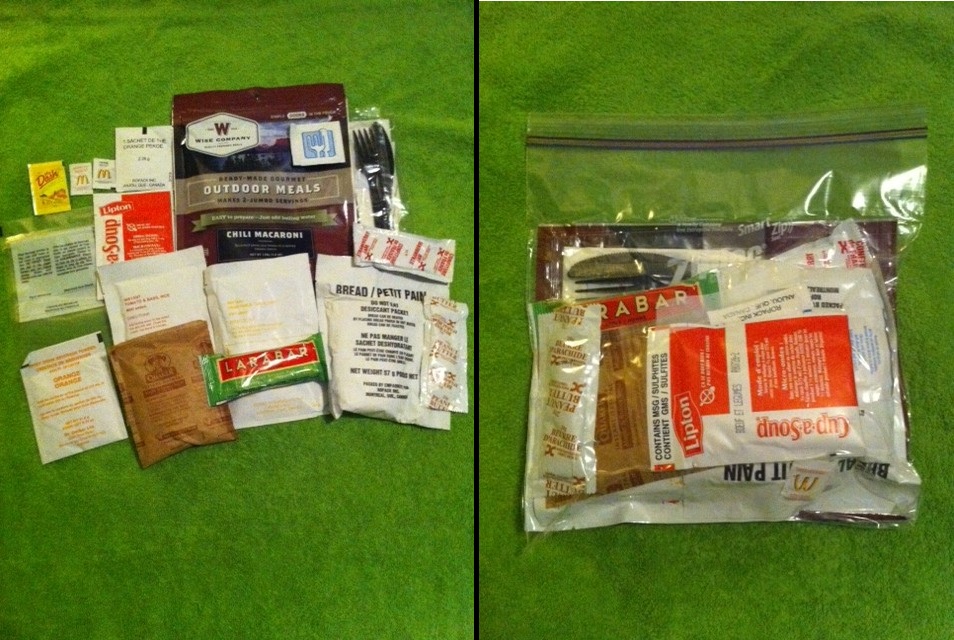
So I made my own MRE. I took apart some of my MRE’s that I got through the army and also searched through my cupboards. Here’s my example:
Freeze dried Chili Mac (made by Wise Company – thanks to TF for sending it!!)
Instant Vegetable Couscous (from a MRE you can make your own, just throw couscous in a bag)
Tomato Basil Rice (from a MRE but you can make your own)
Vegetable Beef Cup of Soup (grocery store)
Bread (from MRE – limited shelf life but I have seen people use vacuum packed tortillas)
Orange sport drink powder (from a MRE but you can get individual sizes at grocery stores)
Peanut Butter and Jam (from MRE but can get from restaurants, also on amazon etc)
Oatmeal (grocery store)
LaraBar energy bar (available here)
Salt, pepper, tea and sugar (available at almost any restaurant… well, buy your own individually wrapped tea bags)
Once you have everything you want, throw it in a bag and vacuum seal it. Or put it in a Ziploc and use a straw to suck out the extra air. I’ve seen people do their own MRE’s with ramen noodles and dehydrated vegetables, macaroni and cheese (out of the box), packets of tuna, soup mixes, anything really. It is easy to go to the grocery store and buy shelf stable items. Just pick something you like and that you’ll eat and throw it all together! Later on, I’ll give you some ideas for the little ones in your survival group
Dehydrating Carrots
I like to dehydrate my own vegetables. I find it is cheaper than buying the #10 cans of dehydrated vegetables. My own dehydrator is sort of lack luster. It was $30 and has large holes so I can’t dehydrate everything I would like to (saving up for a nine tray Excalibur though! ~ update: I got one and love it! You can find one here )
One of my favorite veggies to dehydrate is carrots. They are easy, get super small and I add them to a lot of different dishes (soups, stews, in the pan with roasting meats etc).
To dehydrate carrots, I first peel them and chop off the tops. I then slice them very thin ( 1/8 “) on a mandolin but I have also used a knife (doesn’t take me too long because I was a chef but could take someone with lesser knife skills all day to do the amount as thin as they should be). You need to blanch the carrots next. To do this, plunge the slices into boiling water for about a minute and take them out and put them in ice water. I usually use a metal strainer to put the carrots in the boiling water then I’m not fishing after all the little bits with a slotted spoon. I don’t normally have ice so I just rinse the slices with very cold water to stop the cooking process.
After your carrots have been blanched and cooled quickly, you arrange your carrots in a single layer on your dehydrator trays. My dehydrator has a recommended setting for vegetables (135°) so I set it and leave the carrots for a good 6-8 hours. I then test a couple of pieces of carrots by taking them off the trays, let them cool down then try to bend them. If they bend, put them back in. If they snap or crack, they’re done!
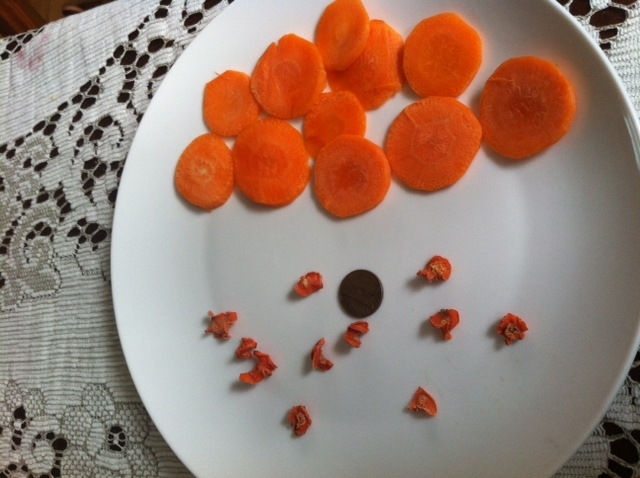
In the picture are raw sliced carrots and the dehydrated carrots. For size comparison, I’ve added an American penny.
Store in vacuum sealed mason jars in a dark place, or in mylar with an oxygen absorber for long term use.
Another Storage Recipe: Scones!
Here’s another recipe you can make using your food storage. I have made this with dehydrated versions of the ingredients and it works well. This is a traditional Irish scone, passed down through the family.
2.5 cups flour
1 tsp baking soda
2.5 tsp baking powder
3 tbsp sugar
1 tsp salt
1/2 c butter
1 egg
1 c buttermilk to mix. (you can also use water or 2% milk for this, it just tastes way better with buttermilk)
You can add a great deal of different things to these. My favorite is to add cheddar cheese (about a cup worth). I have also added raisins, currants, lemon zest, garlic powder, poppy seeds, etc, etc.
Mix it into a thick dough. (You may need to add more milk or more flour). Roll out to 1/4″ – 1/2″ thick. Bake at 375* F for 12-15 minutes.
Enjoy!
Basic Bread
I wanted to share with you a simple bread recipe. I use this recipe all the time at home and it is really easy to make with things that most people have in their long term food storage.
The recipe:
1 lb flour (regular, all purpose flour or whole wheat)
2 tsp of yeast (we keep our yeast in the fridge once opened)
1 tbsp salt
1.5 cups of warm water (not hot)
Mix your ingredients to form a dough and knead for about 10 minutes.
Place your dough in a greased bowl (I use olive oil to lightly coat the inside of a mixing bowl). Cover the bowl with a towel and put it in a warm place for about an hour to let the dough rise.
After the dough has risen and roughly doubled in size, preheat the oven to 500* F.
Punch down the dough and shape it. (It doesn’t have to be pretty. I’ve down round loaves, baguettes, regular loaves and buns with this recipe.)
Place in the oven and turn it down to 450*F. Bake for 30-40 minutes. Remove from the oven and let it rest for at least 20-30 minutes before cutting. It is still cooking during this resting period.
Cut and enjoy. Bread may not be glamorous but in a SHTF situation, it can keep you alive and stretch out any sort of stew or soup you may be eating.

Using Coupons to Prep
I have been using coupons for about 6 months but I have increased my food storage significantly. There is some truth to the popular belief that you can’t buy “good” food with coupons. In my opinion, if you’re starving, any food is good, basically.
I have gotten a lot of food for free or next to free including: pasta noodles, canned vegetables, pasta sauces, soups, soda, bread and yes, even milk.
I’m not too worried about finding produce coupons since I grow my own or buy from the local farmers market, so dried and canned things are great for my food storage.
I have also got for free: laundry soap, shampoo, soap, body wash, toothpaste, mouth wash, feminine products and other hygiene related items. Not to mention a lot of free pet food and supplies (including free kitty litter!)
Most of these are from coupons that you can get sent to you in the mail. I get a coupon (ex: $1.00 off whatever, then wait for whatever to go on sale for a good price and use my coupons. I have found some great prices and got things for .50 cents or free.) Before anyone complains that this sort of thing is only possible on extreme couponing or only in the United States, I’d like to point out that I usually only use one or two coupons at a time, I have never stacked coupons and I do not live in the States. Anyone can do this; it is easy, simple and free.
Another great way to increase your storage is to sign up for free samples. Again, there is a lot more available in the States (*shakes fist at the lucky buggers*) but there is plenty other places. I have a lot of shampoo samples and the like, which fit very well into a bug out bag or can be used to barter.
Again, this is free and simple, it just takes a few minutes of your time to search out and sign up for some of the sample programs. The only thing I would advise is setting up a separate email address because most of the programs send you emails about their specials etc, and if you don’t check your email every day, it can add up quickly.
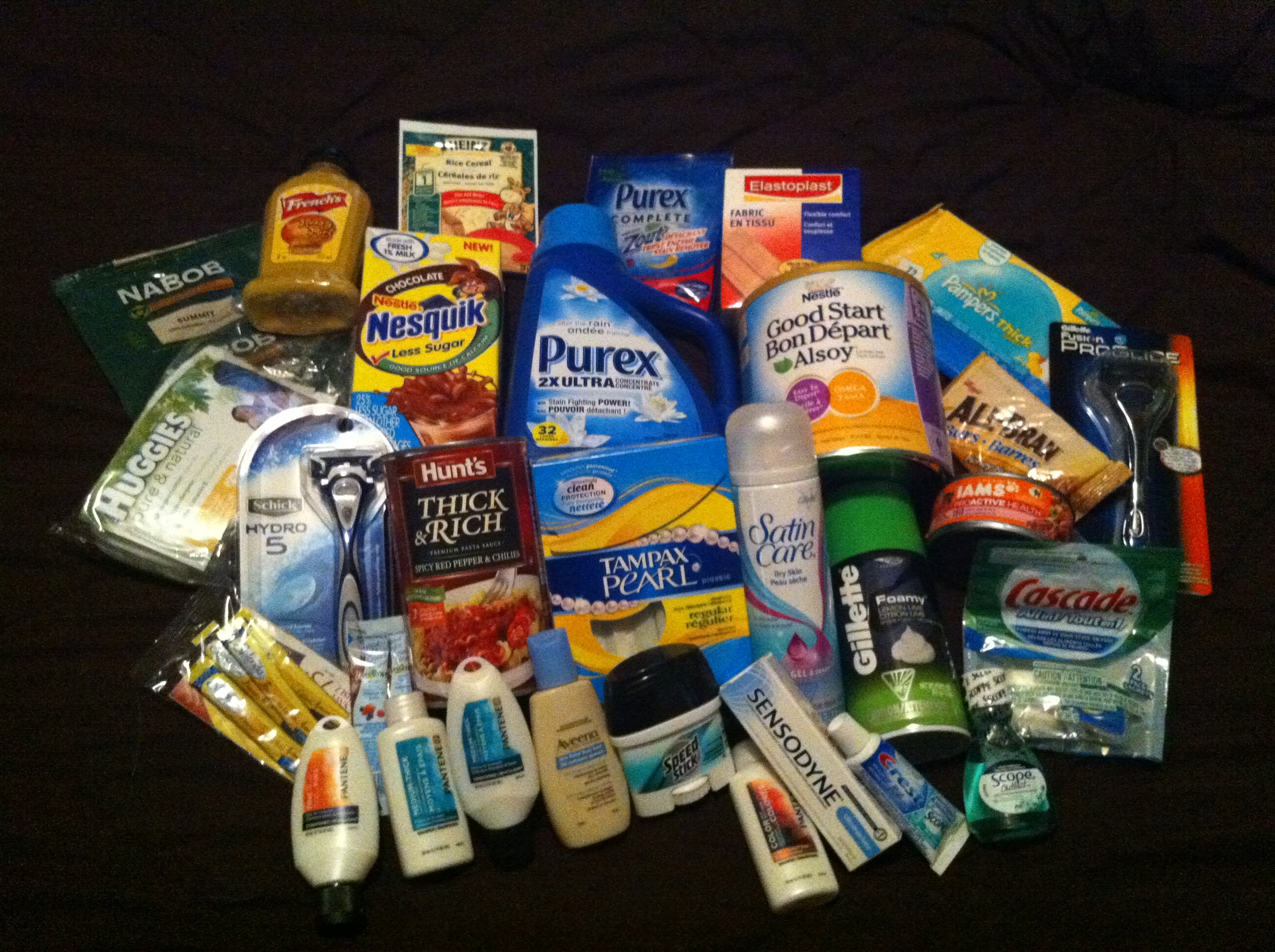
The items in the picture are all things that I have gotten for free either by using coupons or through sample programs, most of the things I have multiples of.
So try it out, you can save money and potentially build up some storage for free!
 BurroakBurrow