Blog Archives
Tea Tree Oil
Tea Tree oil is a great addition to your preps. The plant is native to Australia and is related to eucalyptus. It has been used for centuries as an antibacterial, anti-fungal and infection healing oil. This is the tea tree oil I buy (tea tree oil)
It can be used on almost any skin ailment including blemishes, wounds, dandruff, head lice, chicken pox and blisters. It is fairly effective at killing Candida, which causes yeast infections.
It has similar healing properties to lavender oil (which I wrote about here).
You can grow your own tea tree plant indoors in containers and potentially distill your own essential oils from it but it requires a significant amount of the plant to make a small amount of oil.
It should not be ingested without supervision of a doctor as it can be toxic internally. Some people are sensitive to tea tree, so make sure you check for allergies before using. A simple skin allergy test is to put a drop or two on the inside of the elbow and wait for at least 24 hours to see if there is a reaction (ie: rash, hives or blisters). If there is no reaction, it may be safe to use it in greater quantities. If there IS a reaction, discontinue use.
Some essential oils are not safe for children, animals or pregnant/nursing women. Do your research!
First Aid Supplies
First aid supplies are essential to any prepper’s stocks. The majority of preppers I know have lots of guns, ammo, food and water but barely any medical supplies. It is essential that you know the basics of first aid so you can take care of yourself and your family should something happen. During an emergency, hospitals are generally flooded with patients in varying degrees of illness and injury. It could take hours before you see a doctor and in the case of a pandemic scenario, one of the most likely places to pick up the disease is, of course, the place where all the sick people are hanging out (but if you truly need medical attention, do not hesitate to get it!)
First, I always recommend that everyone take a first aid and CPR course. These courses are generally offered by the Red Cross and other various organizations for very little money and sometimes free. They usually last a day or two and are worth every penny.
Store bought first aid kits are a great start but I like to customize mine with products I’m familiar with using, as well as rounding out some things I find missing. What you put in your kit of course depends on your medical knowledge.
Next, every household should have a bare minimum first aid kit including the following:
gauze
alcohol swabs
antiseptic
band aids
tape
non-latex gloves
tweezers
scissors
safety pins
thermal blanket (for treating shock)
triangle bandage (or large scrap of fabric)
hand sanitizer
maxi pads (can be used as a bandage)
needles and thread (fishing line or dental floss can be used in a pinch for stitches but please make sure your supplies are sterile)
basic medications (including ibuprofen, acetaminophen, anti-diarrheal, anti-nauseant, anti-emetic, etc)
This is just a basic idea of some of the things you should have around the house. Obviously, there is a lot more you can (and probably should) have but having the training to use these things can be a lot more important than the actual supplies. If you know how to treat the injuries, you can improvise the supplies.
I highly recommend having a First Aid manual on hand (paper copy), here’s an example of one I have at home: https://amzn.to/2xeieYT

Using the Tomato Harvest: Salsa!
Every year, I make my own salsa and can it. Every year I make more than the previous year and I still haven’t managed to be able to make it last over the winter. My vegetables this year in the garden did terribly, so when I saw that the grocery store had 50 lbs of tomatoes on for $10, I jumped all over that chance.
Here’s my favorite salsa recipe. I got it originally from my friend Judy (may she rest in peace) and altered it because she doesn’t add nearly enough heat for my family.
Salsa:
8 cups of Roma tomatoes (peeled and chopped)
4 cups onions, chopped
4 cups sweet peppers, chopped
1/4 cup vinegar
5 cloves garlic (or to taste)
Jalepeno pepper or to taste (I usually add a lot of jalepenos and Thai chilies but we like it really spicy)
1/4 to 1/2 tsp oregano (to taste)
1/2 tsp coriander
2-3 tbsp salt
Cook until veggies are done then add a small can of tomato paste. Cook for another
5-10 minutes then put into sterilized jars. Place your filled jars in a water bath canner and process for 20 minutes.
Home canned foods can last a long time but are usually best if consumed within a year to 18 months of canning.

Preserving Corn (While We Can Afford To)
Thanks to the weather conditions all over North America, crops are failing at alarming rates, especially corn. The price of corn has sky rocketed and I can only assume will continue to do so. Corn is of course animal feed but it is also a major ingredient in just about everything we buy today. I went to the farmers market and was asked to buy corn for $5 a dozen (this of course is locally grown but not organic). Later that same week, corn was on sale at the grocery store for $2 for 10 cobs. I grabbed as much of the $2 corn as I could (it also happened to be local).
You can freeze a cob of corn as is. No prep. Don’t shuck it or cook it, just throw it in the freezer (although I usually look for bugs and give it a rinse first). To cook your frozen cobs of corn, you can cook them with the husks on (takes a bit longer) or you can husk them while frozen and just throw the frozen corn in the boiling water just like you would if it was raw. The corn is best if used before 8-12 months in the freezer.
Corn can be canned using a pressure canner. Because it is a low acid food, you cannot properly can corn in a water bath canner. Make sure you use an USDA approved corn canning recipe.
The easiest and most space effective way for me to preserve corn is of course my ever faithful dehydrator (which you can purchase here). To do this, you can cook your corn as if you were going to eat it. Once it is cool to the touch, slice the corn off the cob. Break up the little pieces of corn and spread it out on your dehydrator trays. It takes around 6 hours (or more depending on the humidity in your area) for the corn to dry. I find frozen bagged niblets of corn dehydrate a lot faster (and sometimes nicer) than your own cobs. Once it is dehydrated, you can enjoy it as is for a snack. It is sweet and crunchy (make sure you drink lots of water). You can also grind it into corn meal or corn flour. You can add it, as is, to soup or stews.
I’m personally going to do as much as I can. There has been rumor of the cost of corn going up to $9 a bushel in some areas.
Make sure to store your dehydrated corn in a cool, dry area in a airtight container.

10 cobs of corn fit into one standard sandwich bag when dehydrated
Basic EDC
An EDC, or Every Day Carry, is a kit that you take with you everywhere. It is smaller than a bug out bag and a bit more than most people usually carry. It is a good idea to carry one of these in your backpack, work bag or purse. Do not leave it in your car (I’ll cover car kits another day).
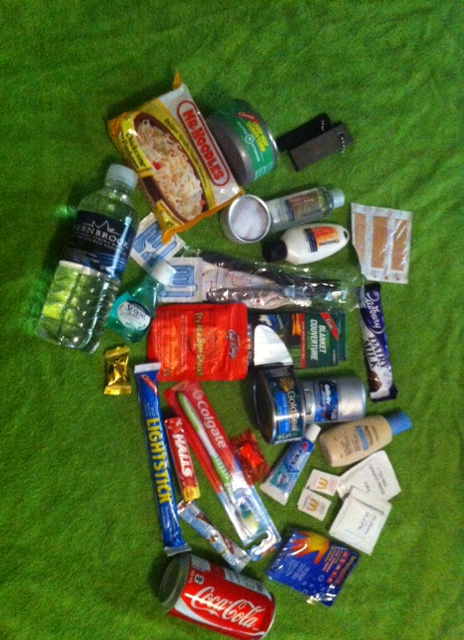
A basic EDC has enough stuff to get you home should you be stranded at work or school. You can think of it as an extended overnight bag if you will, I usually have most of this stuff in my purse. A basic kit might include:
soap
shampoo and conditioner
toothbrush and toothpaste
a can of tuna or other high protein food
a higher carb option (as seen in the picture –ramen noodles)
chocolate or candy
space blanket
a way to start fire
a candle or other heat source
a flashlight or glow stick
tea, coffee or other hot drink
water
a higher sugar and energy content drink (soda or sports drink)
first aid items (the metal tin in my photo contains cotton, ibuprofen and other basic medicines)
Also included (but not seen in the picture) is some money, self-defense tools, a small notebook of basic survival information, basic maps of the city and surroundings, chap stick (which you can use as a fire starter in emergencies) and a book or set of cards in case you get stuck somewhere.
 BurroakBurrow